Milann | The Fertility Specialist

Customer Support Number

9513310580

search

The IVF Journey: A Step-by-Step Walk from Hope to Possibility

The IVF Journey: A Step-by-Step Walk from Hope to Possibility

Learn more about every step of the IVF process from the first consultation to embryo transfer. Learn what to expect, why it matters, and how personalised fertility care makes the difference.

IVF: A Journey That Begins With Hope

While in-vitro fertilisation (IVF) is one of the most advanced fertility treatments available today, it is a deeply human and emotional experience, filled with hope, questions, decisions and emotional strength.
For many, the IVF experience can be exciting and at the same time, overwhelming. This step-by-step guide helps you understand every stage so you can prepare motionally, know what to expect and take the journey ahead with more confidence.

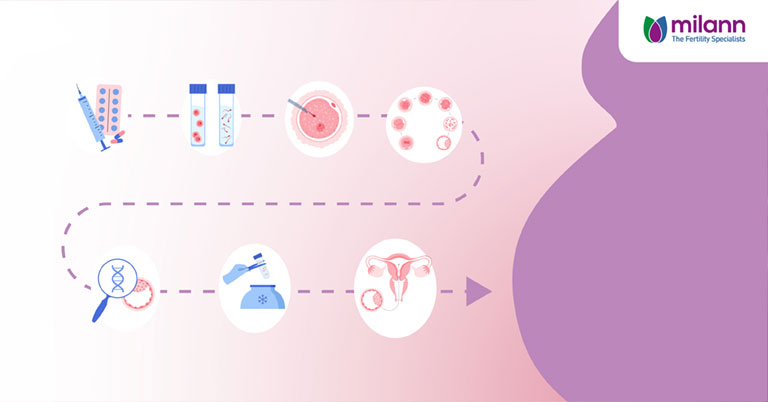
Step 1: Fertility Consultation and Initial Tests

At your first consultation your doctor looks into investigating the root cause behind your unique fertility challenges, and based on this, plan a personalised treatment approach. Your doctor will recommend an initial round of tests to get a better picture of the fertility challenges you and your partner may be facing.

Tests for Women:

  • Hormonal profile: FSH, LH, Estradiol, TSH, Prolactin
  • AMH (Anti-Müllerian Hormone) test
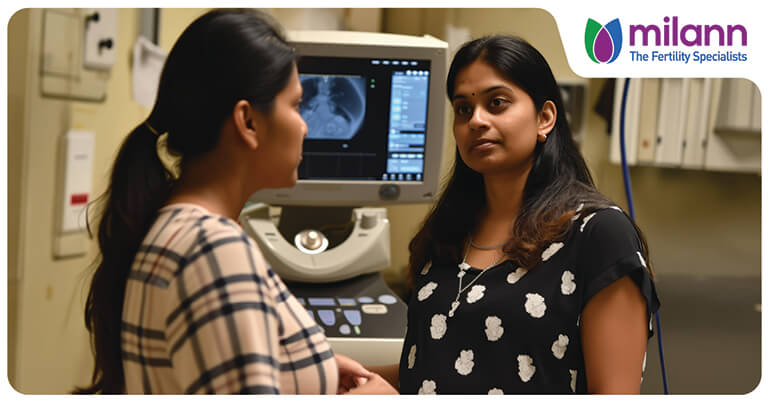
  • Transvaginal ultrasound to assess ovarian reserve and uterine health

Tests for Men:

  • Semen analysis to evaluate sperm count, motility, and morphology
These tests help your doctor device a fertility plan that will work for your case.

Step 2: Ovarian Stimulation and Follicle Monitoring

Based on the test results, and subsequent plan, if your doctor recommends IVF, the next step is often ovarian simulation. To increase the chances of retrieving multiple healthy eggs, your ovaries are gently stimulated with hormonal injections. Regular monitoring is encouraged during this stage and it involves:
  • Ultrasounds to track follicle development
  • Blood tests to measure estradiol and other hormone levels
Your fertility team may adjust the medication based on how your body responds. The goal: develop multiple mature eggs without triggering Ovarian Hyperstimulation Syndrome (OHSS).

Step 3: Egg Retrieval (Oocyte Pick-Up)

When your follicles are ready (usually around day 10–12), you’ll receive a trigger shot to prepare the eggs for collection.
The egg retrieval is a short, painless procedure done under mild sedation:
  • A thin needle is guided via ultrasound to gently collect eggs from your ovaries
  • On the same day, sperm is collected, either through ejaculation or surgical techniques if needed
This step marks the start of fertilisation in the lab.

Step 4: Fertilisation and Embryo Development

Inside the IVF lab, your eggs and sperm are united to create embryos using one of the two methods:
  • Conventional IVF: Eggs and sperm are placed together in a dish
  • ICSI (Intracytoplasmic Sperm Injection): A single sperm is injected directly into the egg—especially helpful for male factor infertility
The resulting embryos are cultured for 3–5 days. Your embryologist monitors their development and may use time-lapse imaging, or PGT-A (genetic screening) to choose the best embryos for transfer.

Step 5: Embryo Transfer – Fresh or Frozen?

This is the most anticipated stage: the moment your embryo is placed into the uterus.
  • It’s a quick, painless procedure done under ultrasound guidance
  • Your doctor may suggest a fresh embryo transfer (within the same cycle) or a frozen embryo transfer (FET), depending on your uterine environment and hormone levels
Frozen transfers allow better uterine preparation, especially if your body needs time to recover post-stimulation.

Step 6: The Two-Week Wait and Beta HCG Test

After embryo transfer, you’ll begin progesterone support and enter the two-week wait—often the most emotionally intense phase.
Try to avoid home pregnancy tests during this time. Instead, wait for the beta HCG blood test, which is done 14 days after transfer. This test confirms whether implantation occurred and whether you’re pregnant.
Self-care, rest, and emotional support are vital during this period.

Step 7: Receiving Results — Interpreting Your Beta HCG Test

  • A positive beta HCG means pregnancy is confirmed, and follow-up scans will begin
  • A negative result can be heartbreaking—but it doesn’t mean IVF can’t work for you. It simply means we need to refine your plan
Your doctor may recommend additional investigations, such as:
  • Preimplantation Genetic Testing (PGT-A)
  • Endometrial Receptivity Analysis (ERA)
  • Immune factor testing
These insights help make your next attempt more targeted and successful.

IVF FAQs —

Q: How many IVF cycles are too many?
There’s no universal number. But if you’ve had multiple failed IVF attempts, it’s time for an advanced consult with multidisciplinary team and deeper testing.
Q: Can my lifestyle really affect IVF success?
Absolutely. Nutrition, sleep, stress, exercise, and maintaining a healthy BMI all contribute to egg/sperm quality and hormonal balance.
Q: Why does IVF fail even when everything looks normal?
Sometimes the cause is subtle—like chromosomal mismatches or uterine receptivity issues. Advanced diagnostics can help uncover these hidden factors.

Why Choose Milann for Your IVF Journey

At Milann Fertility Clinics, we believe IVF success isn’t just about technology—it’s about personalised care, ethical practices, and emotional support.
Our approach includes:
  • Multidisciplinary expertise: Embryologists, endocrinologists, genetic counselors, and fertility nutritionists working together
  • Transparent communication and detailed planning
  • Pre-cycle counseling and post-cycle care, so you never feel lost or alone
Because IVF isn’t just about growing embryos in a lab.
It’s about growing confidence, comfort, and hope—in your heart and in your home.

Ready to Begin Your IVF Journey With Clarity and Confidence?

Book a consultation with Milann today and take the first step toward your fertility goals with expert support by your side.

Reviewed by Dr. Keerthana Ravipati - Consultant - Reproductive Medicine - JP Nagar, HSR Layout.


Share:
© 2025 BACC Healthcare Private Limited, All rights reserved.
  |  
Privacy Policy

We use cookies and IP addresses to improve site performance and understand user interests. This data does not personally identify you unless you voluntarily provide information. Third-party advertisers may also use cookies.

OKPrivacy Policy